Louisiana has exactly one national forest. The Kisatchie covers more than 604,000 acres of federal land, scattered in a checkerboard across seven parishes in the center and north of the state. It is working pine woods, not a fenced-off park: people hunt it, log it, drill a little oil on it, train soldiers on it, and drive to it by the hundreds of thousands every year. It is also, right now, the subject of a fight over whether a large part of it should stop being federal at all.
This guide explains what the Kisatchie is, how it came to exist, what it does today, and — the part that drives most of the politics — how land that can't be taxed still sends money to the parishes that hold it.
The short version#
- The Kisatchie is Louisiana's only national forest: more than 604,000 acres, managed by the U.S. Forest Service from a supervisor's office in Pineville, organized into five ranger districts across seven parishes.
- It was established on June 10, 1930, and assembled from cutover, eroded pine land that timber companies had logged out and walked away from.
- Almost all of it is working timberland. The Forest Service runs one of the largest prescribed-fire programs in the national forest system here to bring back longleaf pine.
- Federal land can't be taxed — but it is not a dead loss for local government. Through two federal programs, Secure Rural Schools and PILT, the parishes get paid. Grant Parish's forest-payment base alone ran about $679,000 in 2024.
- Because it is federal land, no parish can take it. A transfer would require an act of Congress, which is exactly what the current Grant Parish push is trying to arrange.
Where it is, and how it's organized#
The forest is spread, not solid. Its pieces fall in Grant, Natchitoches, Rapides, Vernon, Winn, Webster, and Claiborne parishes, and the Forest Service groups them into five ranger districts — Calcasieu, Caney, Catahoula, Kisatchie, and Winn — run out of the supervisor's office in Pineville, part of the agency's Southern Region.
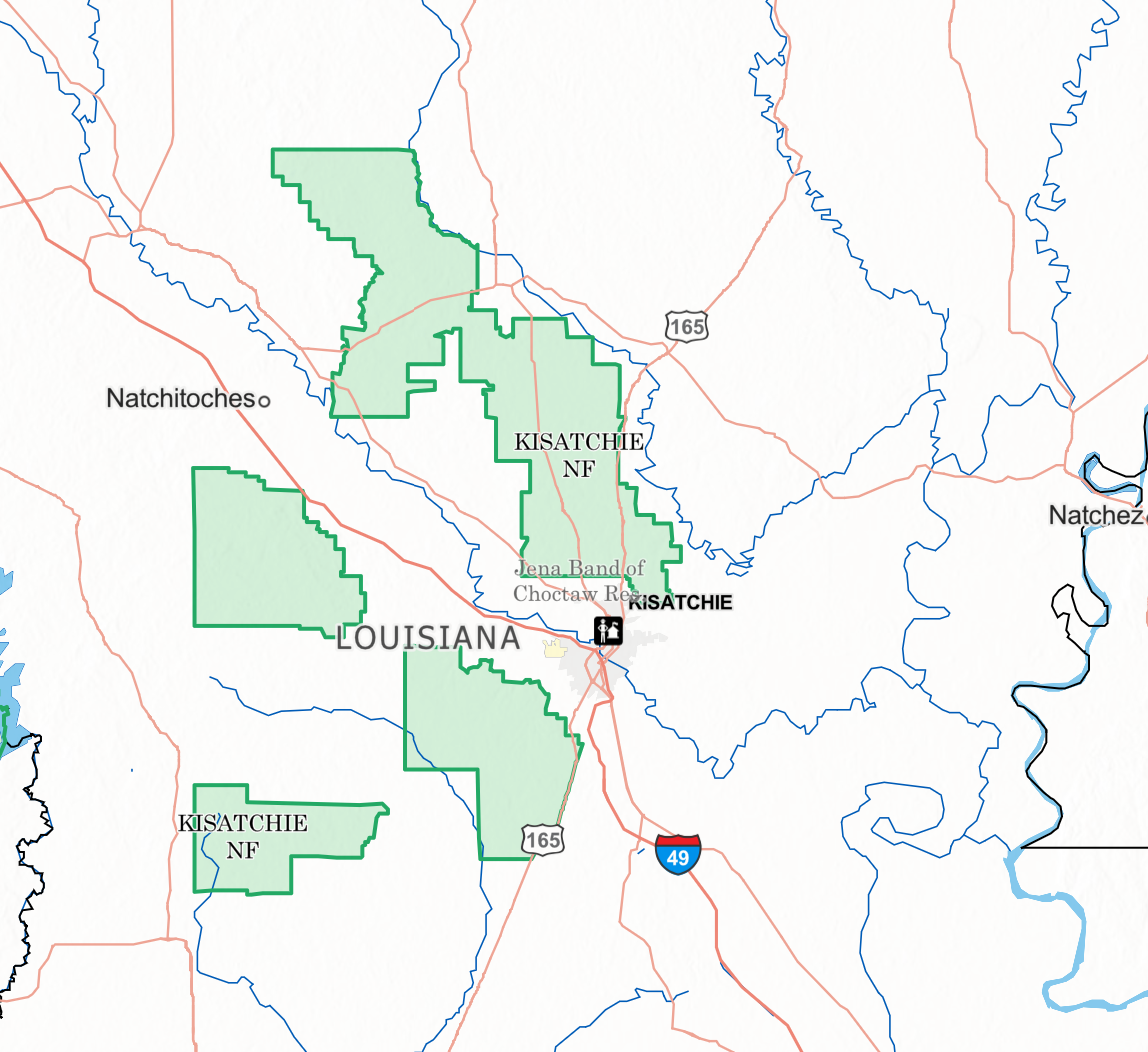
The agency reports its land by district, not by parish, so there is no official "acres in Grant Parish" number. By the local assessor's count, more Kisatchie land lies in Grant Parish than in any other — roughly a third of the whole parish. The district that covers most of it, the Catahoula Ranger District, totals about 121,500 acres and spills into Rapides Parish, too.
From cutover to comeback#
To understand the Kisatchie, you have to picture Louisiana after the timber boom. In the 1800s, virgin forest — much of it longleaf pine — covered most of the state. Then it was cut, fast and nearly clean. The longleaf ecosystem that once spanned some 90 million acres of the South was reduced to a fraction of that by the 1930s, and what remained in central Louisiana was eroded, burned-over, tax-delinquent "cutover" land that nobody wanted.
The federal government bought those tracts under the Weeks Act, the law that let it acquire private land to build eastern national forests, and the Kisatchie was established on June 10, 1930. New Deal crews replanted much of it in the decade that followed. The botanist Caroline Dormon campaigned for its creation, and a trail in the Kisatchie district still carries her name. The name itself comes from the Kichai — also written Kitsatchie — a people of the Caddo Confederacy.
That history is the whole point of the place: it is a made forest, deliberately restored from land the market had ruined.
What the forest does now#
Timber and fire. Almost all of the Kisatchie is timberland, managed for a mix of uses. The signature program is prescribed fire: the forest plan authorizes burning as much as 160,000 acres a year, one of the larger controlled-burn operations in the system, aimed at restoring longleaf pine and the open, fire-dependent habitat it needs. That habitat supports the federally protected red-cockaded woodpecker, whose recovery is a core Forest Service job here.
Wild country. The 8,701-acre Kisatchie Hills Wilderness, designated in 1980, is the only designated wilderness in Louisiana — rugged enough that you reach much of it only on foot or horseback.
Soldiers, oil, and game. The Army trains on Kisatchie land under special-use permits tied to Fort Johnson (formerly Fort Polk). A modest amount of oil and gas is produced under lease. And hunting and fishing throughout the forest are regulated by the Louisiana Department of Wildlife and Fisheries, with several wildlife management areas co-managed by the state.
The economic footprint#
The Kisatchie draws about 350,000 visitors a year, who spend roughly $8 million in the surrounding communities, according to the Forest Service's own benefits summary. Wildlife-related trips — hunting, fishing, watching — make up nearly 40 percent of that. The forest carries about 2,650 miles of roads and 350 miles of trails, and it feeds a working timber supply chain. This is the counterweight that gets less attention in the "unproductive federal land" argument: the forest is an economic engine of a particular, low-key kind.
How "untaxable" federal land still pays the parish#
The main point of contention regarding the Kisatchie National Forest, which is often misunderstood, is that national forest land cannot be included on local property tax rolls. However, this does not mean that the parish completely misses out on revenue. Two federal programs compensate for the loss of tax revenue.
Secure Rural Schools (SRS). Its roots go back to a 1908 law that shares a quarter of a national forest's revenue — timber, leases, fees — with the counties that hold it, with the revenue earmarked for schools and roads. When timber receipts fell in the 1990s, Congress replaced that swing with steadier "decoupled" payments under the Secure Rural Schools program. Louisiana's parishes take the SRS payment. Grant Parish's full-payment base was about $678,951 in 2024 and $685,221 in 2023, according to the Forest Service's county figures.
PILT — Payments in Lieu of Taxes. Separately, the Interior Department pays parishes for hosting untaxable federal land through a program called PILT. Unlike SRS, PILT money can be spent on almost anything. Louisiana's statewide PILT ran about $1.82 million in fiscal 2025. (Don't confuse PILT with a PILOT — the industrial property-tax deal Kingfish has explained separately. Despite the near-identical names, they are unrelated.)
Two catches are worth knowing. The two programs are linked—because a prior year's SRS payment is subtracted from the PILT formula, a larger forest check can shrink the next PILT check. And SRS is not permanent: it has lapsed and been renewed repeatedly, most recently in December 2025 through fiscal 2026, after a gap in which Louisiana missed a payment. That on-again, off-again history is a real vulnerability — and it is the one the transfer's backers point to hardest.
One honest gap: the exact PILT dollars for Grant Parish, specifically, aren't yet published in a form we can cite with confidence. We're pulling them, and we won't put a number on the page until we have it.
The tax-base debate#
Local officials who want the land back make a straightforward case. "The United States Federal Government owns 34 percent of Grant Parish," Sheriff Steven McCain told KALB. "You can't build a home on this 34 percent, you can't have a supermarket … It's all pine trees." Central Louisiana sheriffs argue they patrol the forest without a dedicated reimbursement. The plan's author says local control would generate more tax revenue for water systems and schools.
The counterargument is quieter but concrete, and it lives in the tax code:
- Private timberland is barely taxed either. Louisiana assesses bona fide timberland at 10 percent of its use value, not its market value — so the property taxes the parish "loses" to federal ownership are far smaller than raw acreage suggests.
- The trees are taxed by severance, not property tax, and the parish already gets most of it. Louisiana's constitution makes the severance tax the only tax on timber, and three-quarters of it goes to the parish where the timber is cut. Timber cut by private buyers on national forest land is subject to that tax, too.
- SRS, PILT, recreation spending, and severance already flow in. Add them up, and the "dead loss" is smaller than it sounds.
Which side is right, in dollars? We can't tell you yet — and we won't pretend to. A rigorous, Grant-Parish-specific accounting of what the forest actually costs versus what it returns doesn't appear to exist, and two of the numbers it would require (the current timberland use-value table and Grant Parish's millage rates) are records we haven't finished pulling. When we have them, we'll run the math and show our work.
Can a parish take it? No.#
National Forest System land can change hands only through Congress or a few narrow statutory tools — land exchanges of roughly equal value, or the Small Tracts Act, which handles small, isolated parcels capped well under a hundred acres. To put the scale in perspective: across the entire country, the Forest Service has conveyed less than 500 acres total under the Small Tracts Act since 2007. A transfer of roughly 140,000 acres to a single parish would be extraordinary, and it could happen only by a new act of Congress.
That is why the current effort is a bill, not a parish vote — and why it has drawn the opposition, the counter-resolutions, and the national comparisons we cover in the news piece.
Why you're hearing about it now#
A Grant Parish businessman drafted a plan to move the parish's share of the Kisatchie — roughly a quarter of the whole forest — out of federal hands. He enlisted a since-departed U.S. senator to carry a version of it. The parish government, a state representative, the Louisiana Wildlife Federation, and the Jena Band of Choctaw Indians all opposed it; what actually reached Congress was a narrow tax bill with no forest in it. In late July 2026, the plan's author said he would try again.
We tell that story, and keep it straight from the tax bill it got confused with, here: The plan to transfer part of the Kisatchie, and why Grant Parish rejected it.
How to look it up yourself#
- The forest: the Forest Service's Kisatchie National Forest site and its ranger-district pages.
- The payments: the Secure Rural Schools program and its county reports, and the DOI PILT database.
- The numbers on the parish: Census QuickFacts for Grant Parish and the Grant Parish Assessor.
- The local body that would receive any transfer: what a police jury is — and, when you want the underlying records, how Louisiana's public records law works.
The Kisatchie is a forest in Louisiana, rebuilt from ruined land on purpose over most of a century. Whether it stays federal is now a live question — and it is a better question to argue once you know what the forest is, and what it already gives back.
Spot an error? Receipts welcome: [email protected].