More than 90,000 private water wells operate in Louisiana, by the Health Department's own count. The state knows where most of them are because two people have to file paperwork when one goes in. After that, for most wells in most of the state, the record stops. This is how the system works, and where it ends.
The short version#
- A well generates two filings by two different people. The owner files a notification. The driller files a registration.
- Neither is a permit. Outside a designated critical area, the state's only power over an ordinary well is to fix its spacing.
- The driller's duty applies to every water well in Louisiana, "regardless of yield or use," including a backyard well.
- Monthly pumping reports are required in three north Louisiana areas and the Baton Rouge district. Central Louisiana is in neither.
- Nobody has to test a private well after the first bacteriological sample. Not the owner, not the state.
- A homeowner may legally drill his own well. The exemption is from licensing, not from reporting.
The two filings#
The word "registration" appears in both the statute and the rules, describing different documents. Getting them straight is most of the work.
The owner files a notification. R.S. 38:3097.3(C)(4)(a) directs the state to require registration of new wells by owners, and defines that as "a notice of intent to drill submitted to the secretary at least sixty days prior to drilling the well." The form is GWR-01. For six use types — dewatering, frac water supply, industrial, irrigation, power generation, and public supply — it goes in 60 days before drilling.
Four types file afterward instead, within 60 days of installation: domestic wells, replacement wells, drilling rig supply, and drought relief. Drought relief also needs the secretary's approval first.
The driller files a registration. LAC 56:I.105.A puts this on "the contractor who drills or constructs a well or hole," within 30 days of completion, on Form DNR-GW-1. A well counts as complete when the owner accepts it or the rig leaves the site, whichever comes first.
Three categories escape registration entirely: wells producing saline water in connection with oil or gas production, wells driven or dug by hand auger, and geotechnical boreholes.
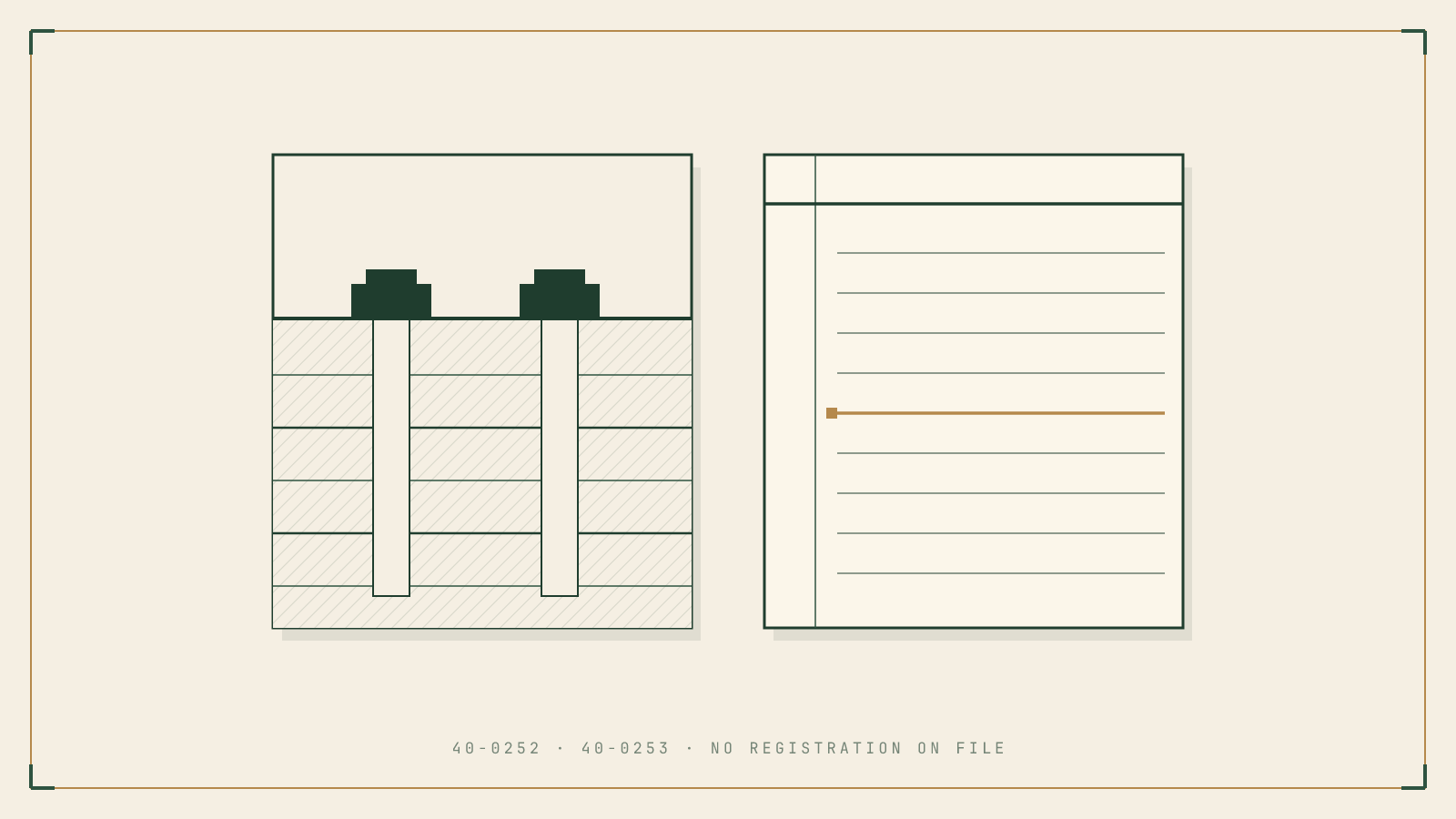
So an irrigation well produces two documents from two parties on two clocks. A domestic well produces one from the driller, which the owner may elect to have satisfy his own obligation.
What the state can do about it#
A notification is not an application, and the response is not an approval. After a notification arrives, the secretary has 30 days to place restrictions, ask for more information, or do nothing. What he may restrict depends on where the well is and how big it is.
For large volume wells — an eight-inch-or-greater screen, or a frac-supply well the agency finds capable of 1,500 gallons a minute — and for wells inside a critical area of ground water concern, the state may fix allowable production, spacing, and metering.
For everything else, the statute is one sentence long: an order "may only fix spacing of the well."
Louisiana has designated areas of ground water concern. It has not designated any critical areas. The difference between those two words decides whether the state can limit how much water comes out of the ground.
Where the reporting is#
Order AGC-1-05, signed August 15, 2005, declared areas of ground water concern in the Sparta Aquifer around three pumping centers: Monroe, Jonesboro-Hodge, and Ruston. Owners of non-domestic wells inside those areas file a monthly ground water usage report — volume pumped, purpose, and static water level where they have it — within 60 days of the end of each month.
The Capital Area Groundwater Conservation District runs a separate regime for East and West Baton Rouge, East and West Feliciana, Pointe Coupee, and Ascension, with its own pumpage reporting and fees.
Everywhere else, including all of central Louisiana, a well owner files a notification and a registration and then files nothing further, whatever the well produces.
Penalties#
R.S. 38:3097.3(F)(2) sets them per day of violation.
| Violation | First | Second | Third and after |
|---|---|---|---|
| Failing to register within 60 days of completion | $0–50 | $50–100 | $100–500 |
| Failing to give 60 days' notice of intent to drill | $0–200 | $200–400 | $400–1,000 |
| Giving no notice before drilling | $500 | $1,000 | $2,500 |
| Failing to comply with a restriction order | $1,000 | $2,500 | $5,000 |
| Failing to comply with a ground water emergency order | $1,000 | $2,500 | $5,000 |
Filing late costs very little. Drilling with no notice at all starts at a flat $500 and rises fivefold by the third offense. Separately, falsifying a required report is a criminal matter under R.S. 38:3095 — up to $5,000, six months, or both, prosecuted by the district attorney.
The well itself#
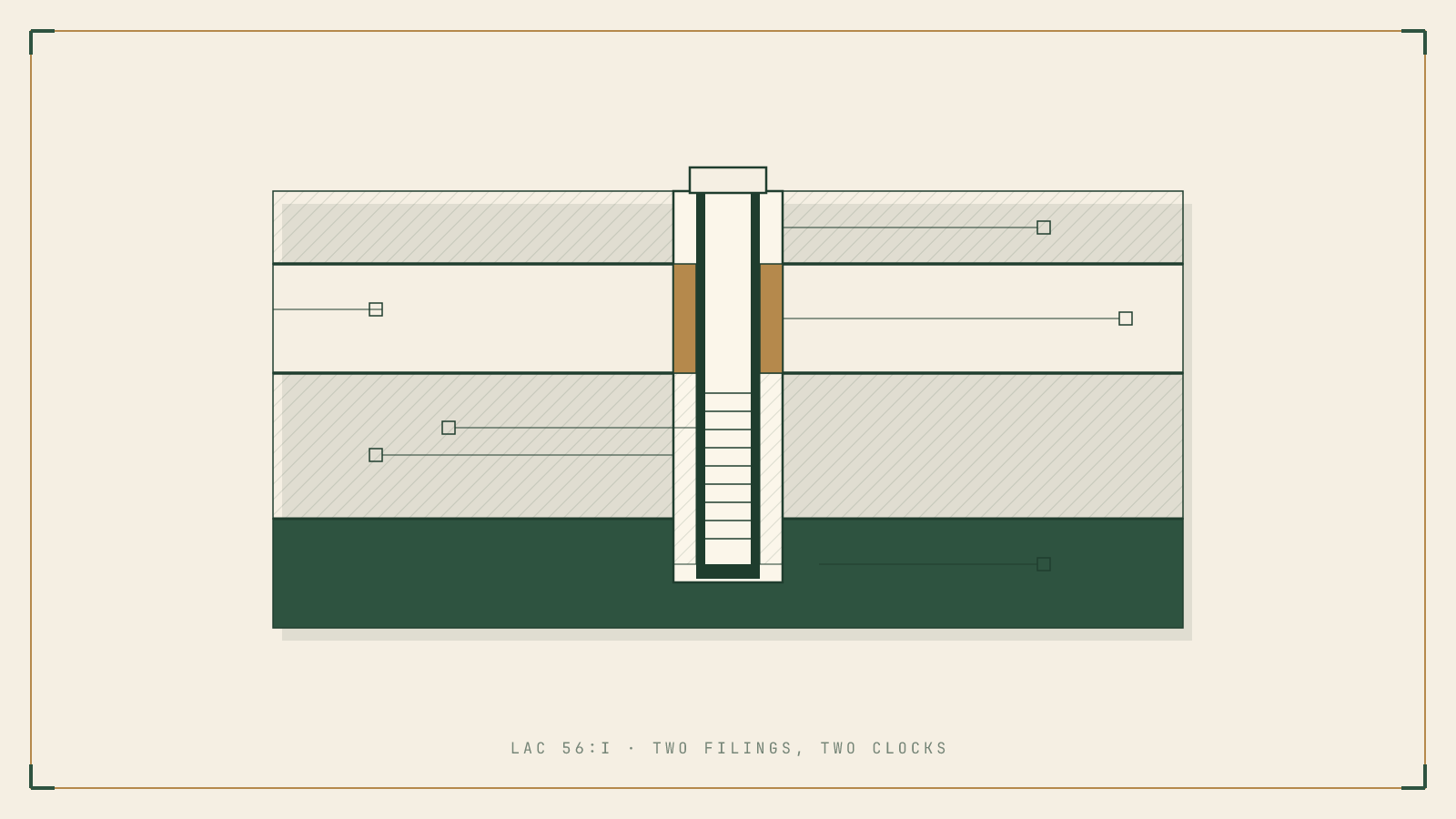
Every part below is prescribed by LAC 56:I, Chapter 3.
A test hole comes first, drilled to the base of the fresh water. It establishes the depth and thickness of the water-bearing sands, produces the cuttings that determine screen slot size, and supplies the water quality data used to size the pump.
Casing holds the hole open, houses the pump, carries the water up, and seals off bad water. It must project at least a foot above ground, pump-house floor, or slab.
The screen is the intake. Slot size comes from a mechanical analysis of the formation samples. Entrance velocity should stay under 0.1 foot per second, the figure that governs both sanding and encrustation. Lengthening the screen raises yield faster than widening the well.
Gravel pack goes in where the sand is fine or thinly bedded, to increase permeability around the screen and cut entrance velocity. Limestone and shale are prohibited as pack material.
The annular seal is the part that decides whether the well is safe. A cement-bentonite slurry pumped from the bottom up fills the gap between the casing and the borehole, keeping surface contamination out of the aquifer and stopping water from moving between aquifers.
How deep that seal has to run is the clearest statement Louisiana makes about whose water it is protecting:
| Well type | Cemented from |
|---|---|
| Community public supply | Full depth — top of the producing aquifer to the surface |
| Industrial, power generation | Full depth |
| Noncommunity public supply | 50 feet to surface |
| Observation, rig supply, dewatering | 50 feet to surface |
| Monitoring | Entire casing length |
| Domestic | 10 feet to surface |
| Irrigation, agricultural | 10 feet to surface |
A well serving a subdivision is sealed the whole way down. A well serving a house is sealed for ten feet.
Setbacks under LAC 56:I.315: 50 feet from a septic tank; 100 feet from cesspools, privies, oxidation ponds, absorption fields and pits, reducible to 50 for a domestic well; 100 feet from landfills, feed lots, and manure piles; 50 feet from a drainage canal, ditch, stream, pond, or lake; and 25 feet from another water well. The rule concedes in its own text that the 25-foot figure "does not take into consideration the effects of interference from pumping nearby wells in the same aquifer."
Testing#
The Health Department's Private Well Initiative states the position plainly: "The Department of Health (LDH) is only required to test and check public water systems. Well owners are responsible for checking and testing their water supply."
One test is mandatory, at the beginning. LAC 56:I.331.F.4 requires every new well, and any repaired well, to be disinfected before use, and requires a negative bacteriological analysis for all public supply and domestic wells from the Office of Public Health or a state-certified lab.
Nothing requires a second one. A well drilled in 1994 and never sampled since is in full compliance.
If you drill your own#
R.S. 38:3098(C) allows an unlicensed person to construct a well on his own or leased property for a single-family house that is his permanent residence, or for watering livestock on his farm, so long as the water is not for public use or any other residence. The same subsection adds that "such person shall comply with all rules and regulations as to the construction of wells."
That exemption covers licensing. It says nothing about the notification and registration duties, which attach to the owner and the contractor. A homeowner who drills his own well is both.
The agency moved, and the paperwork has not caught up#
Acts 2025, No. 458 took effect October 1, 2025. It renamed the department, folded the Office of Conservation into a Water Administration Division of the Department of Conservation and Energy, and moved driller licensing to the State Licensing Board for Contractors.
The published guidance did not follow. LAC 43:VI.701.A still tells readers to register new wells "through the Department of Transportation and Development" — an agency that lost the function on January 1, 2010. LAC 56:I.101 still credits DOTD's Office of Public Works. Both rule sets still say "commissioner" and "Office of Conservation" throughout. The Health Department's private-well page still routes readers to the old office. Anyone following the state's own instructions is sent to two agencies that no longer do this.
How to look up a well#
- Get the Groundwater Resources well number if you have it. It is assigned in the state's acknowledgment letter and belongs on the registration form.
- Search SONRIS, the state database, at sonlite.dnr.state.la.us.
- Ask for the right document. A notification is the owner's filing and shows intent. A registration is the driller's and shows what was built. For depth, screen interval, and aquifer, you want the registration. Those are found on the Documents portal.
- Contact the Water Administration Division at
[email protected]or (225) 342-8244. - For your own well's water quality, contact LDH's Private Well Initiative or a state-certified lab. Nobody will do it for you.
Accountability box: water wells in Louisiana
- What governs them: R.S. 38:3091–3098.8; LAC 56:I (construction and registration); LAC 43:VI (notification).
- Who regulates: Water Administration Division, Department of Conservation and Energy, since October 1, 2025. Driller licensing sits with the State Licensing Board for Contractors.
- Who files: the owner, before or shortly after drilling depending on use type; the driller, within 30 days of completion.
- What the state may impose: spacing, on an ordinary well. Production limits and metering only for large-volume wells or wells in a critical area — of which Louisiana currently has none.
- Ongoing reporting: monthly, for non-domestic wells in the Sparta areas around Monroe, Jonesboro-Hodge, and Ruston, and in the Capital Area district. Nowhere else.
- Water quality testing: one bacteriological test before use. None required after.
- Where the records live: SONRIS.
Louisiana counts its wells carefully at the moment they are drilled and stops counting immediately afterward. For a homeowner, that means the water is his problem permanently. For an industrial user in a parish with no reporting requirement, it means the volume coming out of the ground is a number the state never asks for.
Spot an error? Receipts welcome: [email protected].
Sources#
- R.S. 38:3094 · R.S. 38:3097.3 · R.S. 38:3098
- LAC 56:I — water well construction, registration, and standards
- LAC 43:VI — water well notification
- Department of Conservation and Energy — Water Administration · SONRIS
- Acts 2025, No. 458, effective Oct. 1, 2025 (reorganization)