On Aug. 1, an eight-year suspension of Louisiana's scenic rivers law expired on the Comite River.
The same day, a five-year suspension began on the West Pearl.
It is the third time in eight years the Legislature has released a named waterway from the law's permit requirement, and the second time it has switched the law off for one river entirely. Since Aug. 1, 2018, there has not been a single day on which the statute protecting roughly 3,000 miles of Louisiana rivers, streams, and bayous applied in full to all of them.
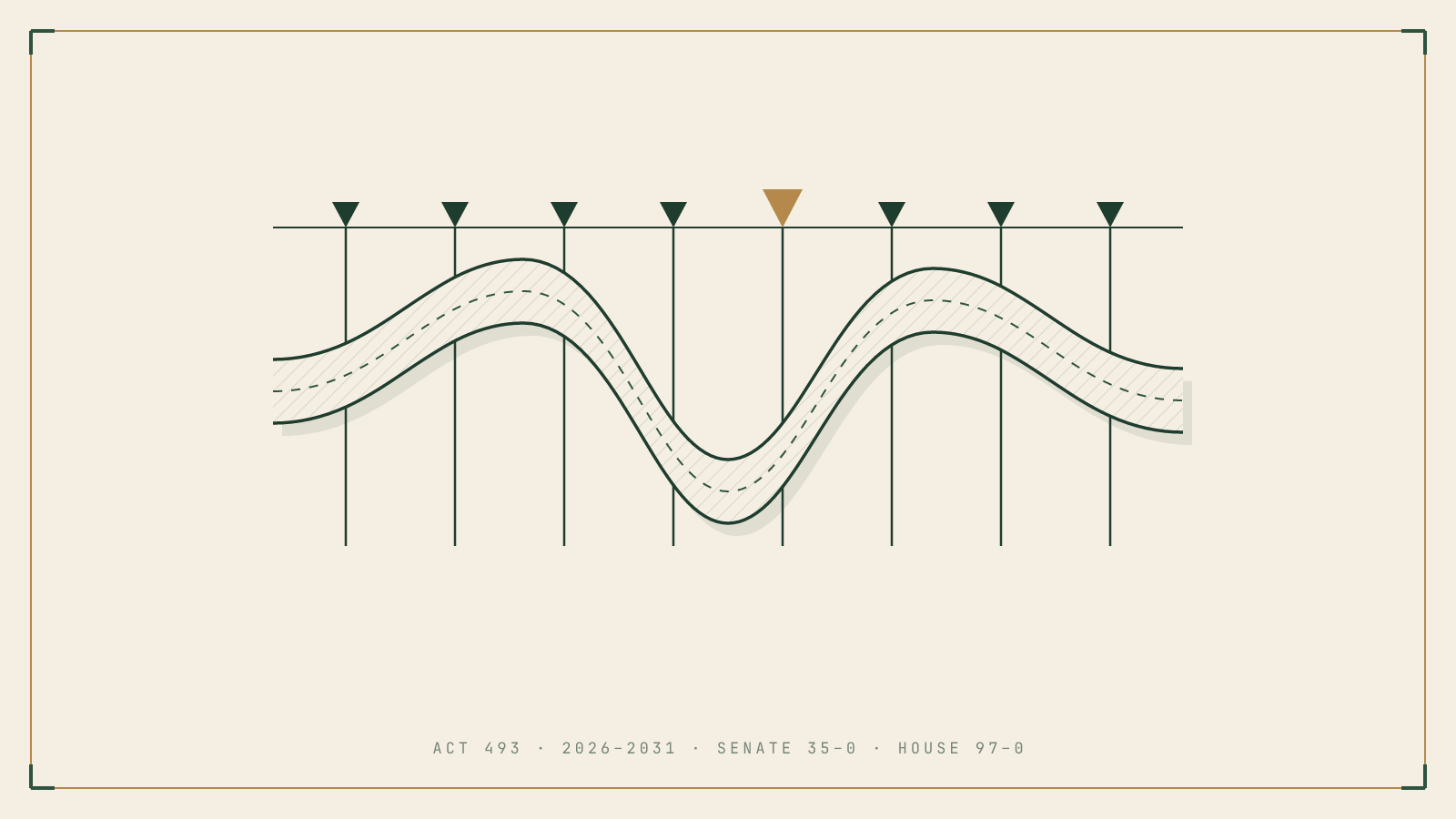
Nobody reported that the new suspension passed. It cleared the Senate 35–0, the House 97–0, and was signed May 29.
The short version#
- Act 493, by Sen. Bob Owen, R-Slidell, suspends the Scenic Rivers Act on the West Pearl River and its tributaries from Lock 1 to the Rigolets — from Aug. 1, 2026, through Aug. 1, 2031. Senate 35–0 on April 21; House 97–0 on May 19; signed May 29. No recorded opposition at any stage.
- The Comite River carried the same suspension under R.S. 56:1855(P). It was enacted in 2018 as a three-year window and extended five more years in 2021. It ended Aug. 1, 2026, the day the West Pearl's began.
- A third waterway, Bayou Manchac, holds a narrower carve-out: since May 2021, a local government needs no permit to clear, snag, and dredge it for drainage. That waiver was also written to expire Aug. 1, 2026. A 2025 act extended it to Dec. 31, 2030.
- Separately, the Wildlife and Fisheries Commission rewrote the program's rules, published June 20, 2026 — creating a class of "general permits" issued with no public comment period at all, including for boring utility and transmission cable beneath a scenic river.
- Neither 2026 change was reported as enacted. The bill got one story, at its introduction in March. The rule drew two briefs in the outdoor press at the notice stage and none on adoption.
What the law does#
The Louisiana Scenic Rivers Act, on the books since 1970, does two things. It bans a list of activities outright on designated waterways — channelization, clearing and snagging, channel realignment, reservoir construction, and dredging — and it requires a permit from the Department of Wildlife and Fisheries for anything else that might degrade a system river. LDWF describes the system as among the largest of its kind in the country.
Act 493 does not amend those protections. It suspends them, for one river, for five years. The operative text, in full:
Notwithstanding any other provision of the law to the contrary, beginning August 1, 2026, through August 1, 2031, no provision of this Part shall:
(1) Prohibit the channelization, clearing and snagging, channel realignment, or dredging operations for drainage purposes in the West Pearl River and its tributaries from Lock 1 to the Rigolets.
(2) Require a permit pursuant to R.S. 56:1849 for the channelization, clearing and snagging, channel realignment, or dredging operations for drainage purposes in the West Pearl River and its tributaries from Lock 1 to the Rigolets.
Two things in that text cut in opposite directions.
It reaches the tributaries, not just the main stem. The bill as filed covered the West Pearl alone, for seven years. The Senate committee that reported it added "and its tributaries" and cut the term to five. Nobody has published a map of what the tributaries language includes.
It does not open the river to development. A third paragraph — added in the same process — provides that the suspension shall not "allow for any new commercial development or clustered residential development along a designated scenic river." The exemption is for drainage work, and the development bar survives it.
The precedent it copies, almost word for word#
Set Act 493 beside the Comite exemption that expired Aug. 1 and you can see the structural similarities.
| Comite — R.S. 56:1855(P) | West Pearl — Act 493 | |
|---|---|---|
| Enacted | 2018 (Act 163, Sen. Bodi White) | 2026 (Act 493, Sen. Bob Owen) |
| Window as written | Aug. 1, 2018 – Aug. 1, 2021 | Aug. 1, 2026 – Aug. 1, 2031 |
| Term as written | Three years | Five years |
| What happened next | Extended in 2021 to Aug. 1, 2026 — eight years in all | Open |
| Prohibitions suspended | Channelization, clearing and snagging, channel realignment, reservoir construction, dredging | Channelization, clearing and snagging, channel realignment, dredging |
| Permit requirement suspended | Yes | Yes |
| Extra provisions | Bans vehicle use in the riverbed during the window | Bars new commercial or clustered residential development |
| Floor votes | Senate 37–0 · House 90–0 | Senate 35–0 · House 97–0 |
The West Pearl version is the narrower of the two. Reservoir construction, suspended on the Comite, stayed prohibited on the Pearl.
But the shape is the same, the mechanism is the same, and the dates interlock.
Scenic Rivers Act · register of carve-outs · 2018–2032
since 2018
the next begins
they could lapse
Table
| Waterway | Act | As enacted | Extended | In force |
|---|---|---|---|---|
| Comite | Act 163 (2018) | 1 Aug 2018 – 1 Aug 2021 | Act 368 (2021) → 1 Aug 2026 | expired 1 Aug 2026 |
| Bayou Manchac | Act 368 (2021) | 1 May 2021 – 1 Aug 2026 | Act 249 (2025) → 31 Dec 2030 | through 31 Dec 2030 |
| West Pearl + tributaries | Act 493 (2026) | 1 Aug 2026 – 1 Aug 2031 | — | through 1 Aug 2031 |
La. R.S. 56:1855(M)(2), (P) · Act 493 of 2026 · legis.la.gov
Three time-limited carve-outs from the Louisiana Scenic Rivers Act, drawn as bars on a shared 2018 to 2032 timeline. The Comite River's suspension ran August 1, 2018 to August 1, 2021 as enacted and was extended to August 1, 2026. Bayou Manchac's local-government drainage permit waiver began May 1, 2021, was due to end August 1, 2026, and was extended to December 31, 2030. The West Pearl River's suspension, tributaries included, runs August 1, 2026 to August 1, 2031. A brass rule marks August 1, 2026, the day the Comite suspension expired and the West Pearl's began. Extensions are drawn as hatched continuations of each bar.
The part that is easy to miss#
Drainage work on the West Pearl was already legal. R.S. 56:1855(O) provides that clearing and snagging and dredging for drainage purposes, "conducted or contracted for by a political subdivision, the state, or federal government," may be permitted by the department on nine named rivers — the Amite, Tangipahoa, Tickfaw, Blind, Tchefuncte, Bogue Falaya, Abita, Comite, and the West Pearl.
The work was already possible. What Act 493 removed is the permit — and with the permit, the file, the review, and the notice.
The windows keep moving#
The Comite suspension was not written as eight years. Act 163 of 2018 set three, through Aug. 1, 2021. As that deadline approached, the Legislature passed Act 368 of 2021, and the enrolled bill shows the fix in one line: "August 1, 2021" struck through, "August 1, 2026" written in.
The same 2021 act opened a third waterway. From May 1, 2021, no permit is required for a local government to clear, snag, and dredge Bayou Manchac for drainage purposes. That waiver was written to end Aug. 1, 2026, alongside the Comite's. It outlived it: Act 249 of 2025 moved the end date to Dec. 31, 2030, a year before the original window would have closed.
The mildest entry came first. Act 430 of 2018 added the Tickfaw and Blind rivers to subsection (O)'s permitted-drainage list — the same list the West Pearl was already on. The permit survives there; those rivers simply joined the roster of places where the department may approve government drainage work.
The record since 2018, then: five named waterways carved out of some part of the Act, two windows extended as they approached expiry, and one window allowed to lapse, on the day its replacement began. In the roll calls on record for the four bills we pulled, not one legislator voted no — 37–0 and 90–0 on the Comite, 89–0, 32–0, and 92–0 on the Tickfaw and Blind, 34–0, 100–0, and 97–0 on the extension, 35–0 and 97–0 on the West Pearl.
The bill before the bill#
Act 493 was the narrow version. Owen's bill the year before, SB 124, would have removed eight St. Tammany Parish waterways from the program outright — about 204 protected miles, The Times-Picayune reported — along with an eight-year West Pearl exemption. It stalled in Senate Natural Resources after residents pushed back and St. Tammany's parish president asked Owen to scale it down. What passed in 2026 was one river, drainage work only, five years.
The rule rewrite#
While the bill moved, the Wildlife and Fisheries Commission was rewriting the program's administrative rules. The package was published at LR 52:985–990 on June 20, 2026, and repromulgated for a typographical error at LR 52:1190–1194 on July 20 — both in the Louisiana Register.
The rewrite shortens evaluation periods, reduces the number of required publications, extends permit terms, and adds a $135-per-day service charge for staff field evaluations. It also loosens the timber rules: commercial selective harvesting within or adjacent to the 100-foot buffer no longer requires a Scenic River Permit, only written notice to the Office of Forestry and LDWF beforehand. The statutory ban on commercial clearcutting within 100 feet stands.
The provision with the widest reach is the new general-permit section. For seven categories of activity that LDWF deems to have no significant deleterious impact, review is expedited, and there is no public comment period. The categories:
- Maintenance of existing structures, including in-kind replacements — expressly including cases where "the original project was unpermitted." Bridges excluded.
- New non-inhabitable overwater structures — docks, piers, boat sheds, walkways — up to 800 square feet.
- New bankline stabilization up to 200 linear feet, minimal backfill, no concrete mats.
- New boring and horizontal directional drilling of sewer lines, water lines, and transmission cables. Overhead lines and rights-of-way excluded.
- Rebuilds and renovations of a single residence or camp, non-commercial.
- Maintenance dredging of existing boat slips and ramps.
- Riparian habitat improvements within the 100-foot buffer.
Most of that list is unremarkable. A homeowner replacing a dock is not a threat to a scenic river, and requiring a comment period for it wastes everyone's time. The Louisiana Wildlife Federation, which follows this program closely, supported parts of the streamlining — clarified timber rules and general permits for minor repairs — while asking for additional safeguards.
Item four is the outlier. Running a transmission cable under a protected river by directional drilling is not dock maintenance, and it is the category most likely to involve a company rather than a landowner.
The rule went through a full public process on paper: a notice of intent approved July 8, 2025, comments open through Oct. 1, amendments approved Feb. 5, 2026, a public hearing March 24. Total press on the rewrite, start to finish: two items in Louisiana Sportsman as the notice of intent moved, and nothing when the rule was adopted. What that process produced — who asked for these changes, and what the comment file says — is not public, and is the next thing we are going to ask for.
Why this matters in central Louisiana#
The Natural and Scenic Rivers System is not a coastal program. Several designated segments run through Cenla, listed stream by stream at R.S. 56:1847:
- The Calcasieu River, from La. Highway 8 east through Vernon Parish — and the entire portion within Rapides Parish.
- Whiskey Chitto Creek, Vernon Parish, from the Fort Polk boundary to the Vernon–Beauregard line.
- Pearl Creek, Vernon Parish, from Highway 111 to the Sabine.
- Kisatchie Bayou, Natchitoches Parish, and Saline Bayou — the state's only National Wild and Scenic River, inside the Kisatchie National Forest.
Neither Act 493 nor the general-permit rule targets any of these. But the rule applies statewide, and the fourth general-permit category — boring a transmission cable under a protected river with no comment period — falls within a parish where two very large energy projects are working out how to move power.
The Sunstripe Solar project near Hineston sits in the Calcasieu's upper watershed and needs a nine-mile, 230-kilovolt transmission line. Cleco has told regulators it intends to build new generation and transmission in Rapides Parish to serve the Delta Forge data center near Boyce.
We have not established that either project's routes cross a designated segment. That is a mapping question — the designated reaches under §1847 laid against the actual routes — and we are working on it. What we can say is that the rule changed the answer to a question that had not been asked: if a route does cross protected water by boring, the review that follows no longer comes with a public comment period.
What we don't know yet#
- Who asked for the rule changes. Which industries, agencies, or landowners drove the notice of intent, and what the comment file says. We are preparing a records request to LDWF for the full file.
- What project is planned on the West Pearl. Sen. Owen told The Times-Picayune in March that part of the river risked changing course, cited silting, and said dredging and weirs were needed. He did not name a project. Matthew Allen of Northshore River Watch said at the time his group could support a project that made sense, but that no details had been provided and Owen had never reached out. Neither has said anything publicly since passage.
- Whether eight years of the Comite exemption delivered. The window has closed, and the drainage work it was passed for can now be counted. Nobody has run that count.
- Where issued permits go. LDWF's permits page lists applications currently open for public comment — four, as of this week. We found no public register of permits already granted, and no listing of general permits at all. A page titled "Scenic Rivers Permits Interactive Map" appears in search-engine indexes; the link returns a 404. We have asked LDWF where the record of issued permits lives.
- The exact before-and-after on evaluation periods and permit terms. We have the adopted rule; the line-by-line comparison against the prior text requires the June Register redline.
We have reached out to Sen. Owen, LDWF's Scenic Rivers program, Northshore River Watch, and the Louisiana Wildlife Federation. We will update this piece as answers come in, and we will say who didn't answer.
How to check this yourself#
- Read the Act. Act 493 is one page. The whole operative text is quoted above. To watch it narrow, compare the bill as filed with the engrossed version.
- Read the exceptions section. R.S. 56:1855 collects every carve-out ever granted. Subsection M(2) is Bayou Manchac; P is the Comite; the West Pearl's Q will appear once the 2026 acts are incorporated. Reading them in order is the fastest way to see the pattern.
- Check whether your water is designated. R.S. 56:1847 lists every protected segment in the state, by parish and by landmark. The stream-by-stream descriptions are easier to search than the statute.
- Watch the bill. SB 331's history page carries every vote and every amendment; LegiScan mirrors the roll calls.
- Read the rule. The Louisiana Register is free and searchable. The scenic rivers package is at LR 52:985 (June 20, 2026) and LR 52:1190 (July 20, 2026).
- Ask LDWF. The Scenic Rivers program publishes contacts and permit information, including the applications currently open for comment.
A five-year suspension is temporary on paper. The Comite's three-year suspension ran eight. Bayou Manchac's waiver was due to end this August and now runs to 2030. Between Aug. 1, 2018 and Aug. 1, 2031, not one day will have passed with the whole Act in force — a condition assembled in unanimous votes, on bills that drew one news story among them, about a law most people do not know exists until someone dredges the creek behind their house.
Spot an error? Receipts welcome: [email protected].
Sources#
- Act 493 (SB 331, 2026 — the West Pearl suspension): enrolled text · history and votes · as filed · engrossed · LegiScan roll calls
- Act 163 (SB 490, 2018 — the Comite suspension, as a three-year window): enrolled text · history and votes
- Act 368 (HB 544, 2021 — the Comite extension and the Bayou Manchac waiver): enrolled text · history and votes
- Act 249 (HB 172, 2025 — the Bayou Manchac extension to Dec. 31, 2030): history and votes
- Act 430 (HB 411, 2018 — Tickfaw and Blind added to the permitted-drainage list): history and votes · LegiScan
- SB 124 of 2025 — Owen's eight-river predecessor bill, stalled in committee
- R.S. 56:1855 — Exceptions (M(2) Bayou Manchac; O, permitted drainage work; P, the Comite) · R.S. 56:1847 — designated rivers and segments · R.S. 56:1853 — prohibited uses · R.S. 56:1854 — commercial cutting of trees
- Louisiana Register (Office of the State Register) — rule at LR 52:985–990 (June 20, 2026), repromulgated LR 52:1190–1194 (July 20, 2026)
- LDWF: Scenic Rivers program · permits · FAQs · prohibited activities · notice of intent, July 2025 · amendments, February 2026
- USDA statewide descriptions of Louisiana's designated streams (PDF)
- Louisiana Wildlife Federation on the proposed rule changes (Sept. 2025)
- Louisiana Sportsman: NOI approved (July 2025) · NOI amended (February 2026)
- The Times-Picayune: SB 331 at introduction (March 18, 2026) · the 2025 eight-river bill (May 2025) — Kingfish did not conduct these interviews; the Owen and Allen quotes belong to that outlet.