Most people who get their water from the Rapides Island Water Association have never been to a board meeting, don't know where the water comes from, and couldn't say who owns the pipe in the yard. That isn't a criticism. It's how a utility is supposed to work. You turn the handle, water comes out.
But RIWA is not a city utility and it is not a company. It is a member-owned nonprofit cooperative, founded in 1972, run by an unpaid board elected from the people it serves, rebuilt with federal money, and documented in a stack of public records almost nobody reads. If you are a customer, you are an owner.
Here is what those records say.
The short version#
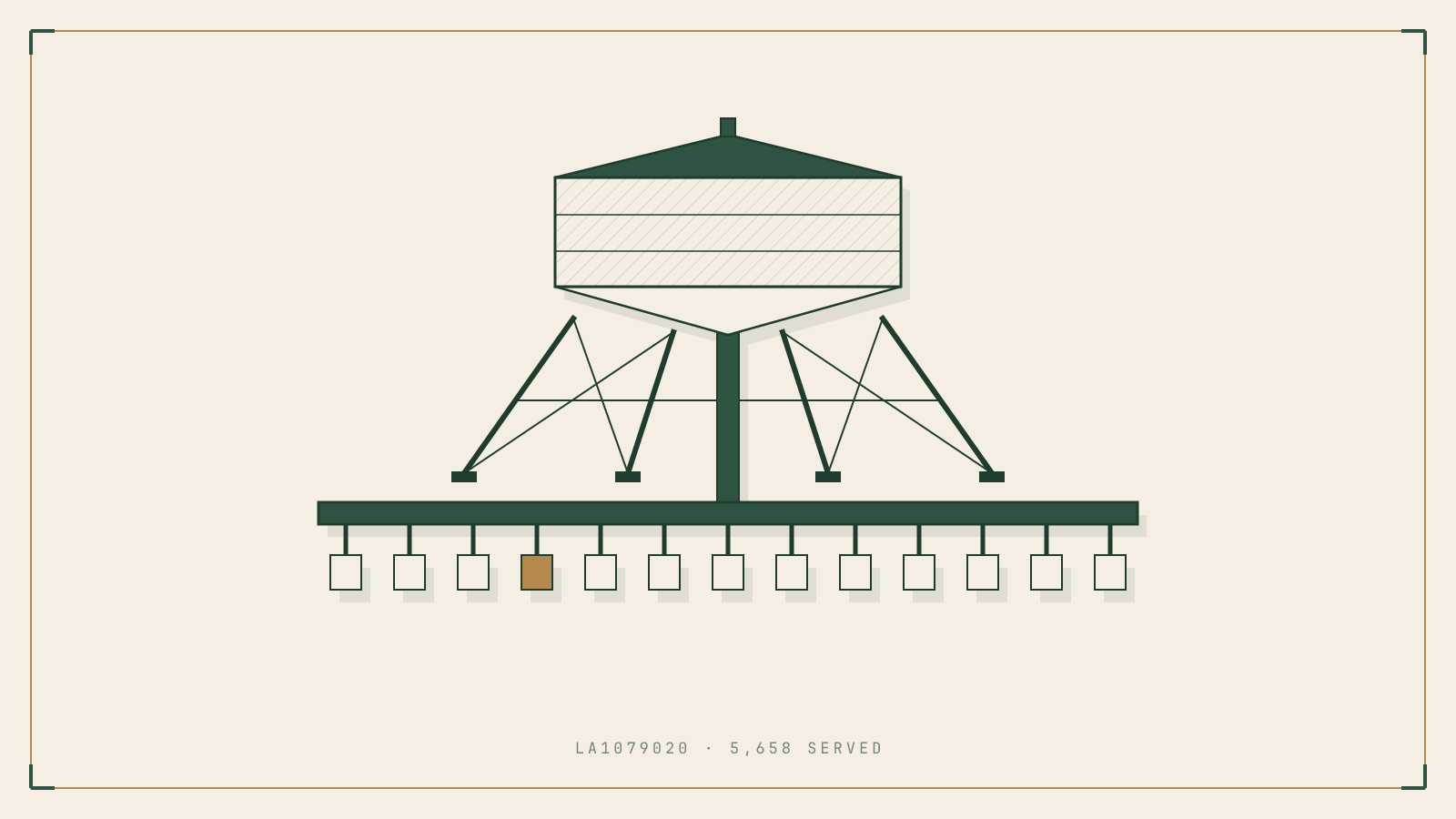
- RIWA is a member-owned rural water cooperative serving 5,658 people through 1,886 service connections west and north of Alexandria, out of an office in Boyce.
- It does not pump all its own water. The co-op runs five wells and also buys finished water from the City of Alexandria at two connections.
- The state gave it an A — 105 out of 100 — in both 2024 and 2025, with zero deductions in all seven categories. EPA's national database lists no violations.
- Its own annual water quality report carries a federally required warning: fluoride above 2.0 mg/L, and children under nine should be given another source of drinking water.
- It has run an operating deficit for four straight years — about $228,000 in the year ending September 2024 — while carrying roughly $4.5 million in federal debt from the rebuild that earned it a state award.
- Nobody sets its rates but its own board. Not the Public Service Commission.
Fast facts#
| Legal name | Rapides Island Water Association, Inc. |
| Type | Member-owned rural water cooperative; IRS 501(c)(12) |
| Founded | 1972 |
| Office | 500-B Ulster Ave. / P.O. Box 458, Boyce, LA 71409 |
| Phone | (318) 793-4812 |
| Website | rapidesislandwater.com |
| Public Water System ID | LA1079020 |
| EIN | 72-0976331 |
| People served | 5,658 |
| Service connections | 1,886 |
| Water source | Five wells, plus purchased water from the City of Alexandria |
| 2025 state water grade | A (105/100) |
| Primary regulator | Louisiana Department of Health, Safe Drinking Water Program |
Population and connection counts are EPA's Safe Drinking Water Information System figures for LA1079020.
The name, and the territory#
"Rapides Island" is the low ground west and north of Alexandria, bounded by the Red River and its old channels — rural without being remote. The service area threads out from Boyce along the highways and parish roads, toward Twin Bridges and out Highway 28, to the edge of where the City of Alexandria's own system stops.
Those boundaries are not informal. Rural water associations file service-area descriptions of record, and where a federally indebted co-op's territory ends turns out to matter a great deal — see the section on federal debt below.
Where the water actually comes from#
This is the part the co-op's own website doesn't answer, and the part most customers get wrong.
RIWA is a groundwater system, but it is not a self-contained one. Its 2024 Consumer Confidence Report lists seven sources: Wells 4, 5, 6 (Shuler Road), 7 and 8 — and two purchase connections, "buys from LA1079001" at McKeithen Drive and at Twin Bridges. LA1079001 is the City of Alexandria. EPA's facility inventory for the system confirms both connections as active, and adds a third, inactive emergency tie to Alexandria on Highway 28 and an emergency connection to the Town of Boyce.
So a meaningful share of the water in these pipes is finished city water, bought wholesale. That single fact links a small independent co-op's supply to the operating condition of a municipal utility it does not control and cannot vote on — which is worth knowing before the next time Alexandria's system has a bad week.
There is no river intake, no surface reservoir, and no treatment plant in the sense a city has one. Groundwater is disinfected, stored, and pumped. That design is cheap, reliable and typical for rural Louisiana.
The wells draw the aquifer system underneath central Rapides Parish. USGS identifies the Carnahan Bayou unit of the Jasper aquifer system as one of the principal freshwater sources in this part of the parish, and reports that water from it is generally moderately hard and, manganese aside, generally within secondary drinking-water standards. We have not confirmed from the state well registry which unit each RIWA well is screened in, or at what depth, and we are not going to print numbers we haven't pulled.
The Legislative Auditor's statewide review, Louisiana's Management of Water Resources, is the best single primer on why "who is pumping how much, from where" is a genuinely hard question to answer in this state.
The report card#
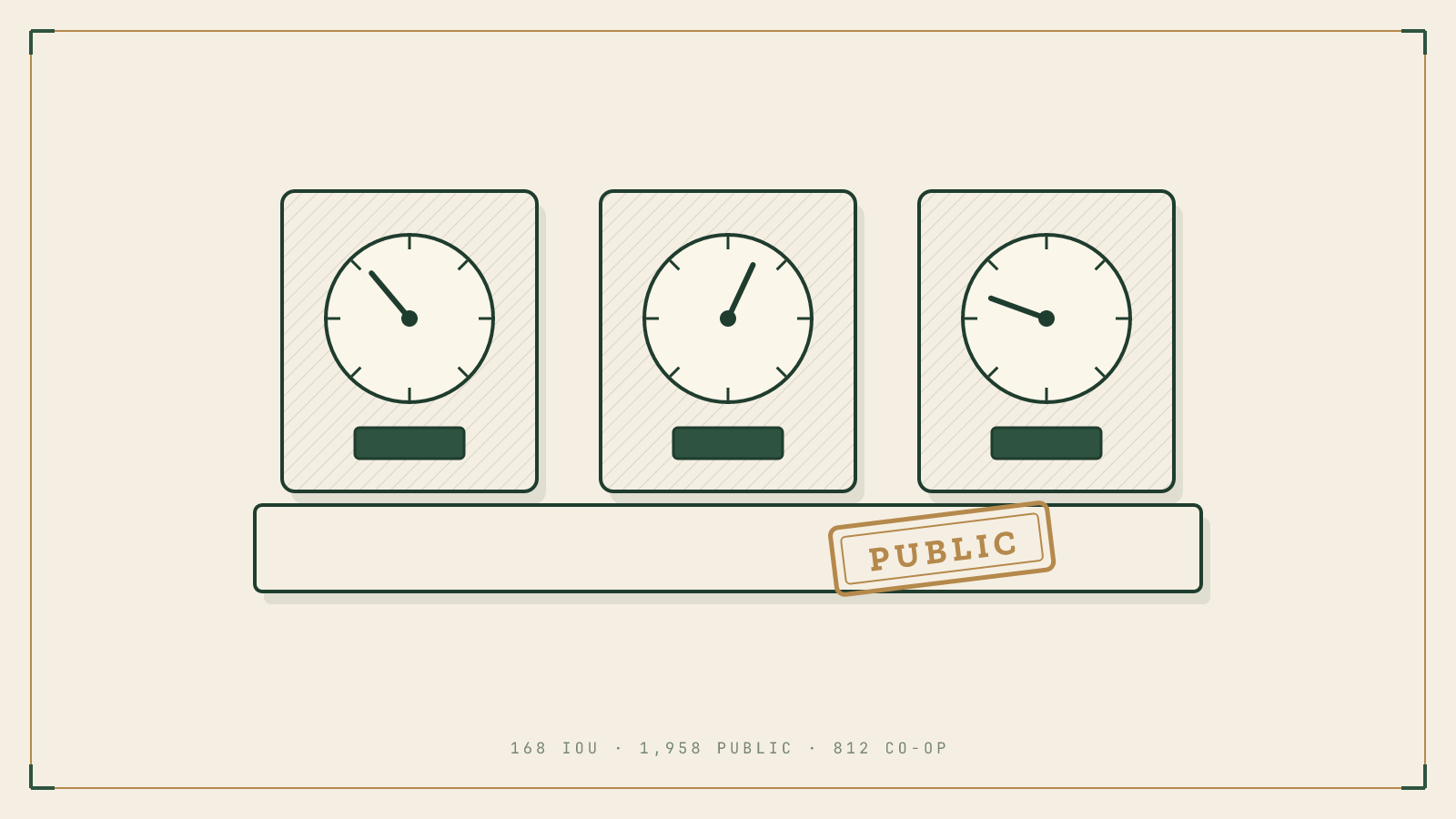
Since Act 98 of the 2021 Regular Session, the Louisiana Department of Health issues every community water system an annual letter grade — the first program of its kind in the country, as national coverage noted at the time. Systems are scored against seven standards and must publish the grade in their annual water quality report.
RIWA's 2025 water grade is an A: 105 out of 100. Its 2024 grade was identical. Both years, the score sheet is clean straight down:
| Standard | Max deduction | RIWA |
|---|---|---|
| Federal water quality | −30 | −0 |
| State water quality | −10 | −0 |
| Financial sustainability | −10 | −0 |
| Operations & maintenance | −15 | −0 |
| Infrastructure | −20 | −0 |
| Customer satisfaction | −10 | −0 |
| Secondary contaminants | −5 | −0 |
| Bonus (asset management, well and storage programs, training) | +10 | +5 |
You can score above 100 because of that bonus line. RIWA took no deductions at all and earned half the available bonus, which is how a system lands at 105 percent.
The detail pages are worth reading rather than the letter alone: no maximum-contaminant-level violations, no Lead and Copper treatment-technique violations, no administrative order, no chlorine violations, no boil notices or outages, a licensed operator on staff, an acceptable rate study, an acceptable audit, no fiscal administrator, no unresolved deficiencies, and a complaint log filed.
That is a very good report card, and it should be said plainly: on the measures the state actually grades, this co-op is running a tight system. Separately, EPA's national compliance database returns no violations for LA1079020 — while the city system it buys from, LA1079001, carries six, two of them health-based. Note that SDWA data in ECHO lags by about a quarter, so neither figure is real-time.
The fluoride notice#
One thing the letter grade does not capture, and the co-op's own annual report does.
The 2024 Consumer Confidence Report reproduces EPA's required health-effects language for fluoride:
The drinking water provided by your community water system has a fluoride concentration greater than 2.0 mg/L. ... Children under nine (9) should be provided with alternative sources of drinking water or water that has been treated to remove the fluoride to avoid the possibility of staining and pitting of their permanent teeth.
The measured numbers behind that notice: treated water at 2.3 ppm on Aug. 27, 2024, ranging 2.2 to 2.3. The 2023 report flagged "fluoride exceed secondary contaminant level." The 2022 report recorded 2.3 ppm in RIWA's own water and 2.4 ppm in the water purchased from Alexandria.
Three things have to be said together, because leaving any one out would mislead:
- This is not a violation. The federal enforceable limit — the maximum contaminant level — is 4.0 ppm, and the co-op is well under it. The 2.0 mg/L threshold is a secondary standard, about cosmetic tooth staining, not a health-based one. That is why the state's grade sheet shows no deduction.
- It appears to be natural, not added. The source water sample taken Dec. 17, 2023 already reads 2.2 ppm — before treatment. Fluoride at that level coming out of the ground points to the aquifer, not to anything the co-op is putting in.
- It still matters to parents. The consequence in the notice is real and permanent, and it applies to a specific group: children under nine. A family that has never opened a Consumer Confidence Report has no way to know.
That last point is the whole reason this guide exists. The information is published, correct, and effectively invisible.
What they built#
The co-op has not been standing still. Between roughly 2018 and 2020 it completed more than $6 million in improvements to what was then a 48-year-old system, financed through a USDA Rural Utilities Service loan and grant package: a new well, an elevated storage tank, two ground storage tanks, a unified control system, about 10 miles of new water mains with hydrants, upgrades to four booster stations, drive-by radio-read meters, generators, and main replacement in the Kincaid/Amelia Drive area.
That program is why the Louisiana Rural Water Association named RIWA its Water System of the Year for the northern part of the state in 2019. For a system this size it is a substantial body of work.
It is also the origin of the debt.
The money#
Small rural water systems in Louisiana live in a permanent squeeze: federal loans build the infrastructure, but the rate base is thin, the pipe is long, and there are few customers per mile. RIWA's federal filings show exactly what that looks like on paper.
The co-op files an IRS Form 990 each year, and those are public. Its fiscal year ends September 30.
| FY | Revenue | Expenses | Result | Total liabilities |
|---|---|---|---|---|
| 2018 | $780,450 | $637,560 | +$142,890 | $104,794 |
| 2019 | $1,166,990 | $887,811 | +$279,179 | $5,127,902 |
| 2020 | $1,876,355 | $1,067,184 | +$809,171 | $4,975,158 |
| 2021 | $1,125,323 | $1,180,473 | −$55,150 | $4,847,835 |
| 2022 | $1,055,026 | $1,324,889 | −$269,863 | $4,761,538 |
| 2023 | $1,059,455 | $1,269,671 | −$210,216 | $4,689,631 |
| 2024 | $1,064,205 | $1,292,361 | −$228,156 | $4,593,110 |
Source: IRS Forms 990, EIN 72-0976331, via ProPublica's Nonprofit Explorer.
Read the liabilities column first. In a single fiscal year the co-op went from a nearly debt-free $2.6 million system to a $7.9 million system carrying $5.1 million in federal debt. That is the rebuild, and it is doing what it was supposed to do — total liabilities have come down every year since, to about $4.59 million at the end of FY2024, of which $4.50 million is secured notes and mortgages.
Now read the revenue column. It has barely moved: $1.055 million in 2022, $1.064 million in 2024 — under one percent in three years. Expenses have run between $1.27 million and $1.32 million throughout. The result is four consecutive years in the red, most recently about $228,000.
One important caveat, stated up front. A paper deficit is not the same as running out of cash. A system that just capitalized roughly $6 million in new assets carries a large depreciation charge against income every year afterward, and depreciation is a bookkeeping entry, not a check anybody writes. The summary 990 data does not break that line out. The audited financial statements do — and that is where a reader who wants the cash picture should go, not here.
The regulator's own read supports caution before alarm: LDH scored financial sustainability at zero deductions in both 2024 and 2025, recording an acceptable rate study, an acceptable audit on file, and no fiscal administrator appointed for poor financial management.
Two structural facts shape all of it:
- USDA debt. The improvements were financed under Section 306 of the Consolidated Farm and Rural Development Act, 7 U.S.C. § 1926. Ratepayers retire that debt over decades.
- Rates are set by the board. RIWA is not regulated by the Louisiana Public Service Commission. That is local control, but it also means a rate increase is a decision neighbors make about neighbors, which is exactly as comfortable as it sounds.
You can read the books. Under Louisiana audit law, R.S. 24:513, the Legislative Auditor has authority to examine or review the financial statements of private water supply systems receiving local or state assistance. Search the entity name in the LLA's public reports database and read the balance sheet and the auditor's findings yourself. Very few people ever do.
Who runs it#
RIWA is governed by an unpaid board of directors elected from the membership, with day-to-day work handled by a small staff. As listed on the co-op's board members page:
- Tracy Breithaupt — President
- Joel Mathews — Vice President
- Ronnie Venson
- Jeff DeKeyzer
- Donna Turnage
- David Gill
- Darron Rachal
The board meets at 8 a.m. on the third Tuesday of each month, and the annual meeting of the members is at 5 p.m. on the first Tuesday in December.
Write those down. As a cooperative, RIWA is not a public body subject to the Open Meetings Law the way a police jury is — but its members are its owners, and the annual meeting is the one night a year the ownership is in the room. The practical route to influence runs through that room: attend, ask for the financial report, run for a seat.
Engineering has come from outside firms rather than staff. The co-op's account of the 2020 project credits Heath McGuffee of Meyer, Meyer, LaCroix & Hixson.
Who regulates it#
This trips people up constantly, so, plainly:
- Water quality and system operations — the Louisiana Department of Health, Safe Drinking Water Program. LDH holds primacy under the federal Safe Drinking Water Act and supervises more than 1,200 public water systems statewide. Boil advisories, sampling, and enforcement run through LDH.
- Finances — the Louisiana Legislative Auditor, under the private-water-system provision above.
- Federal loans and grants — USDA Rural Development.
- Rates — the co-op's own board. Not the Public Service Commission.
- Federal drinking water standards — U.S. EPA, through LDH as the primacy agency.
The Act 98 grading program also requires every system to submit a rate study, annual and financial reports, a flushing plan, and a customer complaint log to LDH each January. Which is why "we're doing a rate study" is often less a local initiative than a state requirement coming due.
A note on 501(c)(12)#
RIWA's federal tax status is not the familiar charity category. It files as a 501(c)(12) — the section covering mutual and cooperative utility companies, the same one that carries rural electric and telephone co-ops.
The defining condition of that section is the 85 percent member-income test: to keep the exemption, at least 85 percent of the organization's income has to come from members, collected for the sole purpose of meeting losses and expenses. It is a legal structure built on the assumption that the customers and the owners are the same people, and that the enterprise is not supposed to make money off them.
That is the frame for everything above. The deficits, the flat revenue, the board-set rates and the volunteer directors are not incidental features of how RIWA is run. They are what the corporate form is.
Why federal debt shapes the map#
Here is the piece almost nobody outside the water business knows, and it explains a great deal about how rural systems behave.
Under 7 U.S.C. § 1926(b), while a rural water association carries outstanding USDA debt, no municipality or competing provider may curtail or limit the service it provides — including by annexation. Congress wrote the provision to stop cities from annexing the profitable customers out of a federally financed rural system and leaving the debt behind.
Courts have distilled it to a short test: the association must have continuing indebtedness to the USDA, and must have provided or made service available to the disputed area. Where both hold, the protection is strong and doubts are generally resolved in the indebted system's favor. The Tenth Circuit's Deer Creek line of cases is a good entry point, and practitioners keep a running index of § 1926(b) litigation.
For a co-op like RIWA — $4.5 million still owed, and a service territory abutting a growing city it also buys water from — that federal debt is simultaneously its heaviest burden and its strongest legal shield.
How to check your own water in five minutes#
You do not have to take our word for any of this. All of it is free and public.
- Your Consumer Confidence Report. Every community water system publishes one annually, listing sources, detections, and violations. Start at LDH's drinking water quality page, or read RIWA's 2024 report directly.
- Your water grade. Pull the one-page report card from LDH's water grade program. Grades are filed by parish and PWSID.
- EPA SDWIS. Search the system ID — LA1079020 — at Envirofacts for inventory, violations, and enforcement history.
- EPA ECHO. Compliance history against systems nationwide, with the quarterly lag noted.
- The 990s and the audits. Read the federal filings at ProPublica's Nonprofit Explorer and search the entity name in the Legislative Auditor's database.
The co-op's own rates, forms and notices are posted under forms and reports and recent news.
Accountability box: Rapides Island Water Association, Inc.
- What it is: A member-owned nonprofit rural water cooperative, IRS 501(c)(12), founded 1972, serving 5,658 people through 1,886 connections west and north of Alexandria.
- Who runs it: Seven unpaid directors elected by the membership; Tracy Breithaupt, president. A licensed operator and office staff handle daily operations.
- Who elects them: The members — meaning the customers.
- Water source: Five wells plus purchased water from the City of Alexandria at two connections.
- Money: $1.06 million revenue against $1.29 million expenses in FY2024, an operating gap of about $228,000; $4.59 million total liabilities, $4.50 million of it secured federal debt; $2.79 million net assets.
- Quality record: State grade A (105/100) in 2024 and 2025; no violations listed in EPA's national database; a standing fluoride notice affecting children under nine.
- When and where it meets: Board, 8 a.m. the third Tuesday monthly. Annual members' meeting, 5 p.m. the first Tuesday in December. 500-B Ulster Ave., Boyce.
- How to reach it: P.O. Box 458, Boyce, LA 71409; (318) 793-4812; office hours 9 a.m. to 4 p.m., Monday–Friday.
Rapides Island Water Association is a fifty-year-old, member-owned, federally financed cooperative that pumps and buys water for about 5,700 people around Boyce. It rebuilt most of its system with USDA money, won a state award for it, and has earned the state's top grade two years running. It is also spending more than it collects, carrying $4.5 million in federal debt, and publishing a fluoride warning that most of the parents it applies to have never read.
All of that is true at once, and all of it is public. It is exactly the sort of institution that shapes daily life for thousands of people and gets no attention at all until something goes wrong.
Spot an error? Receipts welcome: [email protected].
Sources and further reading#
- Rapides Island Water Association — official site · board members · completed improvement projects and 2019 award
- LDH 2025 water grade, LA1079020 · 2024 water grade · water grade program
- LDH 2024 Consumer Confidence Report, LA1079020
- LDH Safe Drinking Water Program · Tracking Drinking Water Quality in Louisiana
- EPA Envirofacts SDWIS search · EPA ECHO SDWA FAQs
- IRS Forms 990, EIN 72-0976331 (ProPublica Nonprofit Explorer)
- Louisiana Legislative Auditor — public reports · Audit Law FAQ
- LLA performance audit: Louisiana's Management of Water Resources
- 7 U.S.C. § 1926 (Cornell LII) · § 1926(b) case index · Deer Creek Water Corp. v. City of Oklahoma City, 82 F.4th 972 (10th Cir. 2023) — slip opinion
- USGS: Hydrogeologic framework of southwestern Louisiana · Water Resources of Vernon Parish
- Circle of Blue on Louisiana's water system letter grades